Showing posts with label EnglishTeaching - grammar. Show all posts

Saturday, June 15, 2013

How Memory Works: 20 Psychological Insights

How Memory Works: 20 Psychological Insights

1
How Memory Works: 10 Things Most People Get Wrong
http://www.spring.org.uk/2012/10/how-memory-works-10-things-most-people-get-wrong.php

2
Why People’s Names Are So Hard to Remember
http://www.spring.org.uk/2011/12/why-peoples-names-are-so-hard-to-remember.php

3
How Memories are Distorted and Invented: Misattribution
http://www.spring.org.uk/2008/02/how-memories-are-distorted-and-invented.php

4
Memory Improved 20% by Nature Walk
http://www.spring.org.uk/2009/01/memory-improved-20-by-nature-walk.php

5
Absent-Mindedness: A Blessing in Disguise?
http://www.spring.org.uk/2008/01/absent-mindedness-blessing-in-disguise.php

6
Mind Pops: Memories That Come From Nowhere
http://www.spring.org.uk/2012/11/mind-pops-memories-that-come-from-nowhere.php

7
How Quickly We Forget: The Transience of Memory
http://www.spring.org.uk/2008/01/how-quickly-we-forget-transience-of.php

8
Reconstructing the Past: How Recalling Memories Alters Them
http://www.spring.org.uk/2013/02/reconstructing-the-past-how-recalling-memories-alters-them.php

9
Can Doodling Improve Memory and Concentration?
http://www.spring.org.uk/2013/01/can-doodling-improve-memory-and-concentration.php

10
On the Tip-of-the-Tongue: Blocked Memories
http://www.spring.org.uk/2008/01/on-tip-of-tongue-blocked-memories.php

11
Six Memory Myths
http://www.spring.org.uk/2011/08/memory-test-whats-your-score.php

12
Memory Improved By Saying Words Aloud
http://www.spring.org.uk/2010/06/memory-improved-by-saying-words-aloud.php

13
Infant Memory Works From Very Early
http://www.spring.org.uk/2008/05/infant-memory-works-from-very-early.php

14
Memories Are Made of This
http://www.spring.org.uk/2008/10/memories-are-made-of-this.php

15
Memory Enhanced by a Simple Break After Reading
http://www.spring.org.uk/2012/08/memory-enhanced-by-a-simple-break-after-reading.php

16
The Persistence of Memory
http://www.spring.org.uk/2008/02/persistence-of-memory.php

17
7 Simple Ways to Improve Your Memory Without Any Training
http://www.spring.org.uk/2011/05/7-simple-ways-to-improve-your-memory-without-any-training.php

18
How the Consistency Bias Warps Our Personal and Political Memories
http://www.spring.org.uk/2008/02/how-consistency-bias-warps-our-personal.php

19
The Temporal Doppler Effect: Why The Future Feels Closer Than The Past
http://www.spring.org.uk/2013/03/the-temporal-doppler-effect-why-the-future-feels-closer-than-the-past.php

20
Implanting False Memories: Lost in the Mall & Paul Ingram
http://www.spring.org.uk/2008/02/implanting-false-memories-lost-in-mall.php


http://www.spring.org.uk/2013/06/how-memory-works-20-psychological-insights.php

Korean universities Teaching Jobs

I don't know about the document you're referring to, but I know that a Master's will make you more employable. Particularly as Korean universities are already planning or making cuts in their staffs (including professors) and programmes (majors/courses).
If you want to teach English, an MA or MEd in English, linguistics, applied linguistics, or TESOL/TEFL would be most valuable, I believe. I know some people who only have Master's degrees and teach in other subjects at universities, but I think these jobs will become rarer as well.
This is mainly speculation, of course, but I know for a fact that cuts are happening or coming in a number of Korean universities because of the decline in the birth rate which will lead to reduced enrollments by somewhere between 2017 and 2020.


I agree with Mathew that uni positions will soon be hard to come by, and already have become quite competitive. Our university has already added a requirement that candidates need two years teaching experience at the university level in addition to an MA, and we are still flooded with qualified applications. Currently, an MA via a distance program can be sufficient, but preference is still given to those who get MAs through traditional programs.

As I have come to understand things, a master's degree is required for advancement into the professor rank (E-1), however, one may still be hired by a university at a level below that, e.g., an instuctor under an E-2 visa. The greatest asset for an entry level hire is not always the master's degree but rather university equivalent years of experience. Once a person has at least 2 years of experience they may seek a teaching position at a uni. Unfortunately, univeraities do not include hakwon experience when calculating the required years of experience a candidate has at the time they apply for a professorship. Hakwon experience is included in the calculation of required years toward an instructor position though.
This blog has run a series of interviews that you might find helpful. http://www.alienteachers.com/1/post/2013/05/ma-tesolapplied-linguistics-interview-1-with-tyson-seburnt.html

Friday, May 24, 2013

EPIK Cultural Shock

Korean base privacy on the status and relationship of that person meaning certain personal information such as age, marital status etc are necessary in order to maintain that relationship.

Koreans give personal information to strangers or casual acquaintances to become more intimate whereas Westerners require intimacy first. We like to know someone first.

Restrictions among western friends are
1. Not borrowing money. We have a saying in the US “If you want to loose a friend loan them money “
2. Respect a friend’s privacy
3. Not putting another under obligation. Again we don’t mind if you ask but learn to accept no without being offended.

Korean ways are
1. Respecting the elderly (though I do not see this on the subways and buses nor with the handicapped or mentally ill) Korean society has been influenced by the West to wait in line, but it is still uncommon. Westerners and Koreans have opposite views on courtesy in a business relationship.
Westerners place business and personal relationships separate as to keep neutrality in decision making and to process quickly. Whereas Korean’s value personal connections for a long-term, trusting business relationship. Both of these practices have their good and bad points. I personally will not rent an apartment to a friend, close associate or a friend or a friend. It can cause too many problems and cause one to make decisions based on that relationship and not what is necessarily good for the business.

Let’s talk about what we are all here for “English Education.” I grew up in a family of teachers and have many friends who are teachers in the US so I was really taken back when I came to Korea.

Though Korea has a national curriculum there seems to be no conformity in English Education. Even in the Universities where Native Teachers have a Master Degree and are teaching Koreans about English Education the majority of their degrees are not in English. In Korea’s thirst for English Education they have been bomb-barded by many Koreans and foreigners who lack the skills or the passion as teachers. In choosing a NT, recruiters first seem to look for someone who is white; between the ages of 22- 35 then they consider their experiences last.

Rumor has it in the foreign community that NT’s will no longer be considered for coveted positions in public schools in Seoul or Busan if you are over 50 and sometimes down to 40. I have seen this myself on the websites. Recruiters have told me to only look for positions in the country or less popular areas.

Korean teachers have too much power in what goes on in the relationship and when something goes wrong they have no where to turn. Again I am lucky at my school as the teachers there are real cool.

(Maybe a board of Koreans and NT’s who are trained in conflict management and cultural differences and can give needed information to live and work in Korea).

2.
Consistency in teaching methods- Though I like to do many things in teaching we want consistency in certain teaching methods. Being from a family of teachers I have learn that students in the elementary schools need to build a solid foundation and some things are just not negotiable.

In the English language there are 220 Sight Words. These are all taught from pre-kindergarten through 3rd grade in western schools. This starts a foundation where children will be able to recognize the meaning of a sentence even though they may not understand every word. At least one sight word is in every sentence in the English language.

In Korea this should be mandatory starting in the first level in which English is taught and should be finished within 4 years or the 6th grade whichever comes first. Students can do many things to learn these sight words through stories, games etc. Word families should also be apart of that program. Scholastic and Spectrum are my favorite companies in providing books etc for this purpose. I can also provide you with other favorites upon request. Most can be bought in Korea. Also word families should be taught in the upper elementary levels. Students want more than anything to be able to talk to foreigners. This can be done by doing Surveys. A great book for this is “The Survey Says” 100 Surveys for Students to Conduct by John Cabot. It gives them a sense of pride and makes them want to continue learning. Yes, English is difficult but like all languages English is based on a timeline and rules. Once these rules are taught it makes it easier to comprehend why English is the way it is. I am including with this essay what I would teach in the ideal situation on the elementary level to build a foundation for the middle schools and above. But since most NT’s only assist and the curriculum in mandatory it makes it more difficult but not impossible.

Most after school programs are also difficult due to the different levels placed in one classroom. How I deal with that is to pair two lower level students with 3 higher level students so they can help them.

I have spent millions of won on my students in Korea. Many NT’s tell me I am crazy and maybe I am. But I love what I do and I love these kids. I believe that to teach English one must also live it. In Korea too much emphasis is based on the tests they take to enter college making English a dreaded and most hated subject among the Korean students.

This is why after years of language learning they still cannot speak it. That is sad. I teach English but I also teach hip hop and yoga (which teaches English words about movement and dance. It also builds confidence. I tell my students that hip hop, like English looks difficult but if you break it down and make it fun it is much easier. Also students in after-school programs need to be able to use English more with foreigners through doing surveys, eating in English restaurants and going where foreigners are.

because really after all the cultural and personal differences are put aside, are we really all that different? I don’t think so. We all want the same things, Love, Happiness and success for ourselves and our children.


Dolch word list SIght Words

Dolch word list

From Wikipedia, the free encyclopedia
Jump to: navigation, search
The Dolch Word List is a list of frequently used words compiled by Edward William Dolch, PhD, a major proponent of the "whole-word" method of beginning reading instruction. The list was prepared in 1936. The list was originally published in his book Problems in Reading in 1948.
Dolch compiled the list based on children's books of his era, which is why nouns such as "kitty" and "Santa Claus" appear on the list instead of more high-frequency words. The list contains 220 "service words" that have to be easily recognized in order to achieve reading fluency in the English language. The compilation excludes nouns, which comprise a separate 95-word list.
These lists of words are still assigned for memorization in American elementary schools. Although most of the 220 Dolch words are phonetic, children are sometimes told that they can't be "sounded out" using common sound-to-letter implicit phonics patterns and have to be learned by sight; hence the alternative term, "sight word." The list is divided into grades in which it was intended that children would memorize these words.

Contents

Dolch list: Non-nouns

Pre-primer: a, and, away, big, blue, can, come, down, find, for, funny, go, help, here, I, in, is, it, jump, little, look, make, me, my, not, one, play, red, run, said, see, the, three, to, two, up, we, where, yellow, you
Primer: all, am, are, at, ate, be, black, brown, but, came, did, do, eat, four, get, good, have, he, into, like, must, new, no, now, on, our, out, please, pretty, ran, ride, saw, say, she, so, soon, that, there, they, this, too, under, want, was, well, went, what, white, who, will, with, yes
1st Grade: after, again, an, any, as, ask, by, could, every, fly, from, give, giving, had, has, her, him, his, how, just, know, let, live, may, of, old, once, open, over, put, round, some, stop, take, thank, them, then, think, walk, were, when
2nd Grade: always, around, because, been, before, best, both, buy, call, cold, does, don't, fast, first, five, found, gave, goes, green, its, made, many, off, or, pull, read, right, sing, sit, sleep, tell, their, these, those, upon, us, use, very, wash, which, why, wish, work, would, write, your
3rd Grade: about, better, bring, carry, clean, cut, done, draw, drink, eight, fall, far, full, got, grow, hold, hot, hurt, if, keep, kind, laugh, light, long, much, myself, never, only, own, pick, seven, shall, show, six, small, start, ten, today, together, try, warm

Dolch list: Nouns

apple, baby, back, ball, bear, bed, bell, bird, birthday, boat, box, boy, bread, brother, cake, car, cat, chair, chicken, children, Christmas, coat, corn, cow, day, dog, doll, door, duck, egg, eye, farm, farmer, father, feet, fire, fish, floor, flower, game, garden, girl, good-bye, grass, ground, hand, head, hill, home, horse, house, kitty, leg, letter, man, men, milk, money, morning, mother, name, nest, night, paper, party, picture, pig, rabbit, rain, ring, robin, Santa Claus, school, seed, sheep, shoe, sister, snow, song, squirrel, stick, street, sun, table, thing, time, top, toy, tree, watch, water, way, wind, window, wood

See also

External links

Culture Shock - 4. Agreeing to an appointment, promise etc and later changing it. ut as a whole we consider a broken promise a character flaw and frown heavily on this practice.

4. Agreeing to an appointment, promise etc and later changing it (Westerners do this to a small degree depending on the situation concerning appointments but as a whole we consider a broken promise a character flaw and frown heavily on this practice. Also the breaking or trying to change a contract is a no- no unless agreed upon by both parties. This is also where manipulation comes in and westerners don’t like to be manipulated. This happened to a native teacher in one of the schools with their contract. In the middle of the year the stipulation changed on the airfare going home in the next year contract and the Korean co teacher asked them to honor the change .Even though their contract was signed the previous year. The native teacher refused saying they wanted to keep the agreement they already signed. This caused a conflict in the relationship. We as foreigners don’t understand this behavior. Koreans sign contracts to buy cars, homes etc. Can they change these agreements on a whim or if their situations change? I hope not. How can a country be a civilized society if agreements mean nothing or excuses are so easily acceptable? This is how westerners generally feel

EPIK - Can you get along with Korean co-teacher? - Relationship with Korean co-teacher is the deciding factor in future work, and career prospects.

EPIK
- Can you get along with Korean co-teacher?
- Relationship with Korean co-teacher is the deciding factor in future work, and career prospects.

Tuesday, May 21, 2013

Employment possibilities in South Korea


Jobs

Employment possibilities in South Korea

As a newly industrializing economy, South Korea offers many opportunities for employment for foreigners; anywhere from teaching English, to international project managers, to placement in high-tech industries.
Jobs
South Korea experienced a financially devastating crisis in 1997. However, its economy has been steadily progressing ever since and continues to grow today.
Following the Asian Financial Crisis of ´97, many Westerners fled the area and took with them the important resource of language. Due to the shortage, English-speaking foreigners are highly sought after in every occupational field. Whether you speak English or not, it is to your advantage to have a high school diploma and a college degree in order to heighten your marketability.

Typical industries and sectors

South Korea is one of the most technologically advanced and digitally linked countries in the world. As a leading exporter of automobiles, cell phones, and other high-tech devices and a growing competitor in information technology, specialists in these fields are needed in Korea.
Seoul, the capital and largest city in Korea, is the center of everything from economy and politics to culture and international business. Some of the world’s largest companies are headquartered in Seoul and its surrounding area.
Aside from its agricultural aspect, most of South Korea’s economic activity takes place in the capital city. It is also easier to find jobs as an English tutor/teacher in big cities like Seoul where the pay tends to go up in proportion to the cost of living. For those looking for work outside of Seoul, other metropolitan cities in South Korea include Busan, Daegu, Daejeon, Gwangju, Incheon, and Ulsan.

Employment trends

Due to the high demand of native English speakers in South Korea, expatriates can easily find jobs tutoring and teaching English. Translators for any industry are also sought after. Most foreigners who choose to teach English in Korea end up working at "hakwons" (private foreign language institutes).
Other popular places to utilize your language skills include:
  • university language institutes
  • corporate in-house language exchange programs
  • private tutoring courses
  • editing/public relations at an advertising company
  • government/private research institutes
Current employment trends show a favorable lean towards certain jobs in:
Finance:
  • fund managers
  • foreign exchange dealers
  • insurance brokers
  • insurance specialists
  • securities analysts
  • stockbrokers
Information technology:
  • database administrators
  • information system analysts
  • Internet consultants
  • IT system consultants
  • network specialists
  • programmers
  • web designers
  • web masters
International business:
  • foreign market researchers
  • international project managers
  • international outsourcing specialists
  • copyright specialists
  • database specialists
  • marketers
  • merchandisers
  • microelectronics specialists
  • robotic specialists
and especially in marketing:
  • direct marketing system designers
  • IR specialists

Further reading

Thursday, April 11, 2013

Study Tip – How to Practice Listening!

Study Tip – How to Practice Listening!

by Melanie on August 21, 2010
(Photo by javierdebe)

You have been studying English for a long time. You have a good knowledge of English grammar and you know lots of words. You can read things in English and you can communicate well in writing. You have trouble understanding what people are saying, however, and it’s impossible for you to watch English movies or TV shows without subtitles. Does that describe you?
You are not alone. Listening is usually the slowest skill to improve. For most language learners, listening is their weakest skill. There are two reasons for this:
  • You may be pronouncing a word incorrectly, and therefore you can’t understand the word when it’s pronounced correctly.
  • You are listening for the wrong words and sounds. Natural spoken English is a mixture of stressed & unstressed words, linked words, contracted words, and reduced words. Many words are not fully pronounced.
Here’s an activity that you can do to improve your listening skills and get used to the sounds of natural spoken English. I learned this activity fromCarl Kwan, and I’ve expanded on his method.

Choose a short audio clip at your level.

If you are a beginner or low intermediate, choose something that is about 1-2 minutes; more advanced learners should choose longer clips that are about 3-5 minutes. Make sure you also have the words to the audio clip. You need to be able to check your work!
Here are some suggestions:
Beginners
Read Theory
Super Easy Reading
(These are reading websites, but there are listening clips for each passage.)
Intermediate & Advanced
The English Teacher Melanie Podcast (American accent)
BBC 6-Minute English (British accent)
BBC Words in the News (British accent)
ESLPod (American accent)

Activity

1. Listen to the whole audio clip once without looking at the words. Relax. Take a deep breath. Don’t panic.
2. Listen to the entire clip again. It’s easier to hear and understand what you’re listening to when you’re relaxed and not panicking.
3. Listen to the clip, but pause the clip every 5 seconds.
  • After you pause the audio, write down a word, phrase or anything you can remember from the clip.
  • When you have finished and listened to the entire clip, read through your notes completely.
  • It’s OK if you don’t understand every word, but can you understand the general theme of what the speaker is saying?
4. Repeat step 4. Check your work. Correct your work. Add any new words you heard.
5. Read through your notes completely again. Try to finish the sentences. If you wrote down one or two words, can you figure out the sentence from those words? Use your knowledge of grammar to try to complete the sentences.
6. Hide your notes. Listen to the clip again, but this time stop after 10 seconds. Again, write down the main words you hear. Check your work compared to what you wrote down in step 5.
7. Listen to the clip completely one last time while reading your notes.
8. Compare your notes to the actual words.
  • What words did you get right?
  • Did you have trouble hearing certain words?
  • Are there any words that you should have heard [words that you already know] but did not? Why? Is your pronunciation wrong? Was the word unstressed in the sentence? Was it linked to a word before or after it?
  • Look up any new words that you don’t know.
9. Listen to the clip while reading the words. Check your pronunciation of words you know but didn’t hear or understand when you were listening.
10. Hide all your notes and the words. Listen one final time to the clip. It should be easier now to understand what the speaker is saying.
11. After about a week, come back and listen to the clip again to refresh your memory.
NOTE: Your listening skills will not improve overnight. Like anything in life, it takes a lot of practice! If you practice consistently 3-4 times a week, soon you will start to see an improvement in your listening skills.
Good luck and happy studying!

Study Tip – Core Vocabulary: The English Words You Need to Know

Study Tip – Core Vocabulary: The English Words You Need to Know

by Melanie on October 29, 2012

Why is it taking so long to learn English?

Do you remember when you started learning English? It was so easy & fun! You learned so many new words and it was easy to learn the words for ‘dog’ and ‘house’ and ‘cheese.’ Before you knew it, you could put together a sentence. One day you realized you could have a basic conversation with someone in English. That was awesome!
Then, something happened, and you’re not quite sure what. It’s taking more and more time now just to make the smallest improvements. When you read something, you still have to look up many words in the dictionary. You learn lots of new words but you can’t remember them all and when you want to explain your opinion, you can’t find the right words to use. You can’t express yourself as clearly as you would like to, or as clearly as you can in your mother tongue/native language.
It seems to be taking a long time to learn English.
Here’s why:
(Source: Oxford Dictionaries)

The Oxford English Corpus (OEC) is a collection of texts (books, newspapers, magazines, blogs, emails, speeches etc.) that shows how the English language is used in real situations. It keeps track of all the words native English speakers use in speaking & writing. It tells us the number of words that English speakers currently use.

A ‘lemma’ is the base form of a word; for example the lemma ‘climb’ includes the different word forms climbs, climbing, and climbed

According to this chart, you only need to know 10 words to understand 25% of what native speakers say and write. You need to know 100 words to understand 50% of what native speakers say & write, and 1000 words to understand 75% of all the words used in common, every day English. That’s why it was so easy to get to the intermediate level.
Congratulations! You already know at least 75% of what native speakers say and write!
Now look at the 90% level. This is the most important part of the chart. Native speakers use just 7000 words for 90% of what they say and write. [Click to tweet this!]
To move from the intermediate level to the advanced/fluent level, you need to learn 6000 more words. That’s why it seems to be taking so long!
Of course, there are more than 7000 words used in English. However, it’s impossible to count all the words in the entire language, and new words are added all the time. Here’s how the Oxford English Dictionary explains English:
English consists of a small number of very common words, a larger number of intermediate ones, and then an indefinitely long ‘tail’ of very rare terms.

Not all English words are equal. Learn the right words.

Those 7000 words are the key to speaking English well. Those 7000 words are the core vocabulary of English. They are the most frequently used words in English. You need to know AND be able to use those words.
The less common words are important, but they are mostly for reference. You need to know them to understand what you’re reading or listening to, but you probably don’t need to use them in your everyday conversations.
You need to spend more time learning the 7000 core vocabulary words, and less time worrying about more advanced, rare words. [Click to tweet this!]

How do I learn the core vocabulary of 7000 words?

1. Learn the right words.

Have you noticed that many words in this article are in red?
The Macmillan Dictionary has a great system called red words. The 7000 words (actually, Macmillan includes 7500 words) that make up the core vocabulary are in red. When you hear or see a new word, look it up in the Macmillan dictionary. If the word is in red, then it is part of the core vocabulary and you need to know this word!


You can see that there are 3 red stars *** after the word ‘opinion.’ This means that ‘opinion’ is one of the 2500 most frequently used words in English. You need to know these words, you need to understand these words, and you need to be able to use them in conversation.
The Macmillan dictionary has very comprehensive entries for red words. For example, in the definition for ‘opinion,’ you can also see collocations, phrases with ‘opinion’, ways of giving your opinion, and metaphors. You can also listen to someone pronounce the word, check different forms of the words, and find related words.

NOTE: The Macmillan dictionary has both British or American definitions. At the bottom of the entry, you can change to the British or American definition:

Here are some red 3-star words that I used in this article. You should learn & be able to use these words:
realize
improve/improvement
quite
express
seem
reference
consist
rare
waste
entry
system
relate
opportunity
clearly
entire
appear
fail
If you are a low-intermediate student, focus on the 3*** words. Make an effort to learn these words. When you feel comfortable with these words, focus on the next 2500 most common words.

Two red stars ** means that the word is one of the next 2500 most common words. Two-star words are part of the core vocabulary, but they are not as frequently used as the 3-star words.
2-star words used in this article:
panic
confident
comprehensive
multiple

One red star * means that the word is one of the next 2500 most common words.
1-star words:
rating
discourage
pace

Words in black in the Macmillan dictionary are not part of the core vocabulary.
In the chart above, the word the calyx appears at the 95% level. This is a black word in the Macmillan dictionary, so it’s not part of the core vocabulary. Also, it says ‘biology’, so I know that this is a word use in science, not in everyday conversations.

2.Pace Yourself

Remember, not only do you need to know a word, you need to be able to use a word. If you try to learn too many words in a day, you’ll forget more than you’ll remember. One to five words a day is a good pace to improve your vocabulary. There is no time limit for learning English! You don’t have to learn every word as fast as possible.
Some words may have multiple definitions. Learn the definition in the context of where you heard/saw the word. Don’t try to memorize every single meaning of the word all at the same time.
Learning English is not a race.

3. Don’t panic. Don’t get discouraged. Be excited!

Seeing or hearing a new word does not mean there is a problem with your English. It does not mean that your English is worse than you thought it was. It’s just another opportunity to improve your English.
Some of my students get angry at themselves when they don’t know a word or can’t remember a word. They think that seeing or hearing a new word means they have failed & they have not yet ‘mastered’ English.
You’ll will be learning new English words for the rest of your life. Read that sentence again. Even native speakers are always learning new words, so don’t get angry with yourself because you don’t know every word in the English language. You will never know every word in the English language. I don’t know every word in the English language!
Be excited when you see a new word!
~

What do you think? Are you ready to focus on core vocabulary? How can you add core vocabulary to your daily studies?

Friday, April 5, 2013

10 Secrets to Landing a Korean University Job

10 Secrets to Landing a Korean University Job

Kim Yu-na, the famous figure skater, at her class at Korea University.


Teaching English at a Korean university is one of the best ESL jobs on the planet. With almost 400 colleges in the country, why aren’t you working at one?

Do you want to teach at a Korean university?

Find work at UniJobsKorea.com!


If you’ve spent any time at all in Korea then you know that teaching at a university is the Holy Grail of ESL jobs. Why? How does 4 months or more of paid vacation sound to you? Not enough? Most university lecturers teach around 14 hours per week and get one or two days off per week, and you don’t have to desk-warm between classes.
Having loads of free time isn’t the only thing university jobs have going for them. The students are pretty cool to work with as well. Yes, it’s true that many Korean university students kick back and relax once they’ve made it into college. However, they are easier to deal with and more respectful than a class of 40 screaming primary school students.
Next, you won’t have a co-teacher. The class is yours. Yes, you will have a director or foreign teacher supervisor to answer to, but generally you are left alone to run your class as you like.
The best part is you can use your extra free time to pursue a hobby, further your education, or make some extra money. Many university teachers double or even triple their salary by teaching private classes on the side. Of course this is illegal in Korea (unless you marry a Korean) but everyone does it.
Job Description
Keep in mind that all university jobs are different. There is no standard. In general you can expect the following:
Teaching hours: 10-20 per week (the standard is around 14-16).
Salary: 1.8 to 2.8 million per month (around $25k or more after taxes), which varies depending on qualifications, experience, and school location.
Housing: many universities provide housing or a stipend of around 300,000 won per month.
Bonus: public universities provide an end-of-year bonus equivalent to one month’s salary, private universities usually don’t.
Pension & Health Care: all universities are required by law to provide a pension (about 10% of your yearly salary) and health care.
Contract Duration: usually for one year but sometimes 2. A few universities will force you out after 3 years.
Airfare reimbursement: occasionally a university will pay for your roundtrip airfare but it is rare.
Requirements
Don’t you need an MA to teach at a university? No. Korean universities ask for a minimum of 1-year teaching experience if you have a Master’s degree (in any subject – does not have to be in TESOL or English related) or 3 years teaching experience if you don’t have a MA.
You also need to have a passport from either the UK, US, Canada, South Africa, New Zealand or Australia. You can’t have a criminal record.
You’re Hired
As you can imagine these jobs are highly competitive. Just look at anyone who has lived in Korea for some time. You’ll see that almost every “lifer” works at a university. So how do you get one of these jobs? Here are a few tips:
1. Know the Right People
The number one key to getting a job at a Korean university is to know someone on the inside. Korean culture is all about circles: personal relationships are key.
The best university jobs are rarely advertised on the Internet job boards. For every university job posting there are 100 public school or academy job offers. Why? When a position opens up the university usually knows about it far in advance. Instead of posting an ad on the Internet, the university will ask the foreign teachers at that school to recommend their friends.
One university I worked at had almost 30 foreign teachers. If each teacher recommends the job to 10 of their friends that means the school already has 300 applicants. Why should the school advertise on an Internet job board?
2. Join Professional Associations

So how do you network in Korea? First, get to know as many university teachers as possible. Anytime you meet a university teacher you should “friend” them on Facebook. Ask them questions about where they teach and what it is like. Let them know you are looking for a job.
Next, join a teaching association. The largest in Korea is KOTESOL. Find your local chapter. Join it. Go to the meetings and conferences. This is your number one place in Korea to network with English teachers. More importantly, it is a fantastic resource for your own professional development…and it looks good on your résumé. Another association for English teachers in Korea is ATEK.
3. Be Proactive in Your Job Hunt
You have to go after these jobs. You won’t find them on Korean university job boards like Uni Jobs Korea. First, decide what city you want to live in. For example, if you want to live in Busan, then visit the city and grab a tourist map. You will see there are over 20 universities in Busan alone. Next, look up the schools on the Internet or get a Korean friend to find the phone number of the English department. Call and ask who is in charge of hiring new teachers. Introduce yourself, find out if they are hiring, and send your résumé.
4. Get Some Experience In Korea
Although it is possible to get a university job before you come to Korea, it’s quite difficult. Most employers want to see that you have at least one year of teaching experience (it doesn’t have to be at a university) in Korea. It can be at a public school or private academy.
5. Know the Hiring Seasons
The Korean school year starts with the spring semester in March. More teachers tend to get hired during the spring semester. The fall semester starts in September. Therefore, there are two main hiring seasons: November-December and May-June.
It is true that some universities do things at the last-minute and hire teachers a few weeks before the semester starts. However, you want to get your job search going in full swing during those prime hiring months.
6. Get Qualified
If you have an MA in TESOL or Linguistics then you shouldn’t have much trouble finding work. There are no guarantees but more and more university teachers are getting their MA these days.
A second cheaper and quicker option is to get a CELTA or TEFL certification.  CELTA courses take about one month and cost around $2,000. There are also many TEFL certification courses online that will certify you for under $300. Just be sure your course is at least 100 hours and that it states the number of hours on your certificate.
7. Make Your MA Work For You
When most people think of teaching abroad they assume they can only teach English. This is absolutely not the case in Korea. There is a huge demand for university professors with Masters degrees that can teach major subjects in English. This is a trend that is not going away and will only continue to get bigger in the future.
For instance, if you have an MBA you can teach business – in English of course – to Korean university students. Try contacting the department related to your area of study and ask them if they are hiring. These jobs often pay double or more of what you would make teaching English.
8. Look the Part
Koreans are highly image conscious. Got gray hair? Dye it. Is your suit a little old or out of style? Buy a new one. Was your photo on your resume taken at home on your couch? Get photo taken professionally and have it photoshopped. If you don’t wear a suit and tie or your best dress to your interview you might as well not show up.
9. Pay Your Dues
Korea has 4 tiers of universities according to competitiveness. At the top-tier you have the SKY universities (Seoul National, Korea Univ., and Yonsei Univ.). They are like American Ivy league universities. The 4th tier universities are the least competitive and similar to community colleges in the US.
The secret to getting your first uni job in, especially if you don’t have any university teaching experience, is to aim for the lower tier universities. More importantly, look for universities outside of major cities.
Most people who have been in Korea for some time prefer to live in the major cities like Seoul, Busan, or Daegu. As a result, universities that are far from major cities have a more difficult time finding qualified applicants.
For instance, there are only a handful of universities left in Seoul that don’t require an MA. However, there are plenty of universities in other parts of the country that will hire you with just a BA.
10. Beware of the Unigwan
Usually the want ad says you will teach 20-30 hours per week and have 2 weeks or less of vacation. You will probably be working in the university’s private language academy and teach everything from primary school kids to adults. The only university students you teach are the ones who come after class for extra help.
These are by no means bad jobs, and can actually lead to full time work in another university or department. However, if you have the qualifications to get a true university gig then don’t waste your time at a unigwan.
For more information, be sure to visit the Uni Jobs Korea Blog. You can also read Jackie Bolen’s blog: My Life! Teaching in a Korean University. Great stuff Jackie!

Thursday, April 4, 2013

Meaning, then, comes from understanding what a thing IS NOT rather than from knowing in any kind of ontological sense what a thing IS.

English speakers construct meaning by distinguishing between tree and treat and trek as well as between tree and bush and flower.

Meaning, then, comes from understanding what a thing IS NOT rather than from knowing in any kind of ontological sense what a thing IS.

Meaning, then, comes from understanding what a thing IS NOT rather than from knowing in any kind of ontological sense what a thing IS. Meaning is constructed through difference, particularly through binary pairs (man/woman, good/evil). There is no absolute Platonic ideal "out there" to anchor meaning. There is no truth that is not constructed. There is nothing outside language. Language speaks (through) us. Language is thus a system of signs or a semiotic system, but merely one of many, all of which construct meaning, which does not exist outside the semiotic system.


---

He argued that the relationship between the spoken word (signifier) and object (signified) is arbitrary and that meaning comes through the relationship between signs, which are for Saussure the union of signified and signifier. So the word "tree" means  image of tree by custom only and not through any intrinsic relationship between the sound and the thing. That's why both "arbol" and "tree" can both signify the same signified. 
Saturday, March 30, 2013

Your teaching should be one that supports and encourages student learning.

Evaluating your Teaching:

Your teaching should be one that supports and encourages student learning.


Evaluating your teaching is crucial to further developing your learning and teaching skills, and to become a good teacher.

Task-Based Learning:

Task-Based Learning:

Makes the performance of meaningful tasks central to the learning process.
It is informed by the belief that if students are focused on the completion of a task, they are just as likely to learn language as they are if they are focusing on language forms.

Instead of a language structure or function to be learnt, students are presented with a task they have to perform or a problem they have to solve.
For example, after a class performs some pre-task activities which involve questions and vocabulary checking (i.e. what is this? It's a timetable. What does 'arrival' mean?), they ask and answer questions to solve a problem, such as finding train-timetable information, eg. when does the Brindavan express leave Madras/arrive in Bangalore?.

Task-based learning is sort of like a PPP upside down.
Students are given a task to perform and only when the task has been completed does the teacher discuss the language that was used, making corrections and adjustments which the students' performance of the task has shown to be desirable.

Pre-task: Introduction to topic and task
Task Cycle: Task -> Planning -> Report
Language Focus: Analysis -> Pratice.


Learn Sounds not Symbols: (Learn how to have conversation, not grammar rules).

Learn Sounds not Symbols: (Learn how to have conversation, not grammar rules).
The symbol is the not the sound, just as a church or a lake on the map is not actually a church or a lake! The aim of this approach is to experience sounds and sequences of sound in a personal, physical, muscular way, and to use the phonemic symbol as a visual hook for that physical and auditory experience. It is sounds that are being studied, not symbols.

I would tend to value those directly respond to learner needs (eg. I think this will be useful for them) over those that are only (or primarily) following a pre-set list

There are many valid reason for choosing what to teach.

I would tend to value those directly respond to learner needs (eg. I think this will be useful for them) over those that are only (or primarily) following a pre-set list (eg. It's the language featured in the next coursebook unit).

Friday, March 29, 2013

English Teaching Resources

Resources
Associations
World Association for Online Education The World Association for Online Education is a free membership organization and consists of individual educators concerned with e-learning.
Exam Resources
BULATS Practice The Business Language Testing Service (BULATS) is a multi-level test designed for companies and organisations. It is used to test English as well as French, German and Spanish.
Free TOEFL Practice The Test of English as a Foreign Language (TOEFL) measures the ability of non-native speakers of English to use and understand North American English as it is spoken, written and heard in college and university settings.
IELTS Exam Preparation IELTS, the International English Language Testing System, is designed to assess the language ability of candidates who need to study or work where English is the language of communication.
Grammar Resources
English Grammar Grammar lessons, exercises, and rules for everyday use.
English Page Free online English lessons & ESL / EFL resources.
Grammar Slammer! Grammar Slammer, the help file that goes beyond a grammar checker.
Grammar Tutorials In these tutorials, you can learn about and practice the use of the passive voice, different verb tenses, or articles like a, an, or the.
HyperGrammar HyperGrammar electronic grammar course at the University of Ottawa’s Writing Centre.
Mary’s Grammar Exercises 28 chapters of grammar exercises.
Punctuation Made Simple In “Punctuation Made Simple,” we discuss several of the most useful punctuation marks that you will use as a communicator. Instead of listing many rules, as a grammar book does, we discuss these various marks in general so that you can get a sense of how to use them in your own prose.
Lesson Plans
Apples English Innovative ways to use the internet in ESL classrooms.
Breaking News English Free, 13-page, ready-to-print EFL/ESL lesson plans on current events.
ESL Flow Lesson plans and ideas for teachers.
Famous People Lessons EFL / ESL lesson plans using biographies and profiles.
TES Lesson Plans Save yourself preparation time by downloading free lesson plans. To find the most recent resources, simply select ‘Primary’ or ‘Secondary’ then click on the ‘phase’ e.g. ‘KS1’, followed by ‘newest’ and ‘subject’.
References
All Words English dictionary with multi-lingual search.
Dictionary Reliable, free online access to millions of English definitions, synonyms, spelling, audio pronunciations, example sentences, and translations from Dictionary.com.
OneLook OneLook dictionary search.
Thesaurus Reliable, free online access to millions of English definitions, synonyms, spelling, audio pronunciations, example sentences, and translations from Thesaurus.com.
Student Resources
BBC Learning English An excellent online resource courtesy of the British Broadcasting Corporation.
British Council Learn English Learn English online with the help of this free website from the British Council with games, stories, listening activities and grammar exercises.
Many Things This web site is for people studying English as a Second Language (ESL) or English as a Foreign Language (EFL). There are quizzes, word games, word puzzles, proverbs, slang expressions, anagrams, a random-sentence generator and other computer assisted language learning activities.
Teacher Resources
Culture Shock! Guidebooks A range of Culture Shock! books published by Marshall Cavendish which are perfect for getting to know more about the culture in many popular TEFL destinations.
Developing Teachers A website for the developing language teacher.
E.L.Easton English materials for teaching and learning.
Fair Languages A source for trends, tips, resources and information for language learners and teachers & tutors.
Guardian TEFL TEFL news from one of Britain’s finest newspapers.
Teacher Printables Hundreds of free printable teaching resources for teachers to quickly print off and use in their classrooms
Teaching English in Italy Advice and FAQs from TJ Taylor Language Training.
TES TES Teaching Resources is where teachers share and download free lesson plans, classroom resources, revision guides and curriculum worksheets.
VipEnglish TEFL resources, activities and lesson plans for teachers of advanced English.
XE Currency Converter  The world’s favourite currency and foreign exchange site.
Vocabulary
A Word A Day Come, explore the world of words, share, and delight in the joy of words.
Acronym Finder With more than 1,000,000 human-edited definitions, Acronym Finder is the world’s largest and most comprehensive dictionary of acronyms, abbreviations, and initialisms.
Irregular Verbs All the irregular verbs of the English language. Conjugation, pronunciation, translation and examples.
My Word – Prefixes The purpose of this project is to develop, demonstrate and promote a better way for people to clear up the meaning of a word.
Listening
BBC Radio Learn English with audio courtesy of the BBC.
British Council Podcasts Practise your English language listening skills with Elementary Podcasts. Listen to them on your computer, or download them to your mp3 player or smartphone.
English Listening Listening is a natural way to learn a language. We offer a very easy way
to learn English: Just Listen. Enjoy!
ESL Podcasts ESL Podcast is designed to help you continue to improve your English.
Focus English Enjoy learning conversational English online.
Fonetiks Online pronunciation guides to 9 varieties of the English language and 9 other languages.
Learn English Now LearnEnglishNow offers 265 free audio English lessons.
Lingual.net Learn English with video and games.
Randall’s ESL Lab Listen to everyday conversations with adult and children’s voices.
TEFL Iberia A collection of video activities – they consist of 2-3 minute videos followed by the script and some comprehension check questions.
Voice of America News Read, listen and learn with news and more.
Reading
Aesop’s Fables An online collection of Aesop’s Fables includes a total of 655+ Fables, indexed in table format, with morals listed.
Bartleby Unlimited access to great books online.
English for Everyone Printable reading comprehension worksheets.
ESL Fast 365 short stories for intermediate ESL learners.
Literacy Net Comprehension activities with multimedia features.
News in Levels Easy English reading and listening.
Project Gutenberg Project Gutenberg offers over 40,000 free ebooks: choose among free epub books, free kindle books, download them or read them online.
Public Literature Only the finest in online classics.
Soon The magazine with the answers! Advice on visiting Britain and visa problems, learning English, interviews, problems of life, sex, science, religion and stories.
Speaking
ESL Galaxy ESL communicative lesson plan resources.
ESL Gold English speaking and conversation practice.
Writing
Academic English Café Learn English online at your own pace! Take free English language quizzes, practice academic vocabulary, find great books on learning English, read model essays, listen to authentic English language programs and more!
ESL Gold English writing and composition help.
Guide to Writing an Essay An essay can have many purposes, but the basic structure is the same no matter what. You may be writing an essay to argue for a particular point of view or to explain the steps necessary to complete a task. Either way, your essay will have the same basic format.
WritingDEN WritingDEN is designed for students Grades 6 through 12 seeking to improve their English reading, comprehension, and writing skills. WritingDEN is divided into three levels of difficulty: Words, Sentences and Paragraphs.
If you would like to suggest a new online resource please email worldoftefl@gmail.com

Monday, March 25, 2013

Why is grammar important? (Grammar Revolution Documentary!)


Subordinate Clauses55

Subordinate Clauses


Review: Main Clauses

A main clause is any BSP or any BSP + its bound modifiers.

Two other important definitions:


  • A clause, whether it is a main clause or some other kind of clause, contains a subject (noun) and a predicate (verb).
  • A phrase or cluster is a cluster of words that does NOT contain both a subject and a predicate.

FORMATION OF FREE MODIFIERS:

We will be studying the following structures: subordinate clauses, verb clusters, adjective clusters, noun clusters, absolutes, free relative clauses. These clauses and phrases are known as free modifiers because they are outside the BSP kernel clause; they are normally set off from the main clause with a comma.

Formation of Subordinate Clauses:

To make a subordinate clause, add a clause subordinator to the beginning of any main clause; then supply a new main clause to support it.
Jim arrived early.
Since Jim arrived early,
Since Jim arrived early, he didn't have to wait.

Clause Subordinators: after, although, as, because, before, even though, if, once, since, though, unless, until, when

More Examples:

Constance sighed.
When Constance sighed,
When Constance sighed, the other people in the room turned to see who had done it.

The dog barked incessantly at night.
Because the dog barked incessantly at night,
Because the dog barked incessantly at night, the neighbors finally lodged a complaint with the town board.


Detecting Subordinate Clauses

When you are analyzing the sentence structure of a passage, you can pay attention to the writer's use of subordinate clauses. To find them, look for one of the clause subordinators listed above. Then look at the words following the subordinator. If they would be a main clause by themselves, then you have found a subordinate clause. If they form only a phrase or if there is only a single word after the subordinator, then you do not have a subordinate clause: usually you are looking at a prepositional phrase.
Notice the paragraph just above this one. It contains the following subordinate clauses:
When you are analyzing the sentence structure of a passage, If they would be a main clause by themselves,
If they form only a phrase
if there is only a single word after the subordinator,
Let's now mark that same paragraph to highlight the sentences which contain subordinate clauses and to emphasize the subordinate clauses themselves. In this example, I have italicized the sentences that have subordinate clauses, and I have boldfaced the subordinate clauses themselves. When you are analyzing the sentence structure of a passage, you can pay attention to the writer's use of subordinate clauses. To find them, look for one of the clause subordinators listed above. Then look at the words following the subordinator. If they would be a main clause by themselves, then you have found a subordinate clause. If they form only a phrase or if there is only a single word after the subordinator, then you do not have a subordinate clause: usually you are looking at a prepositional phrase. Return to Lesson Five

The Eight Parts of Speech Are Super Cool

The Eight Parts of Speech
Are Super Cool

Every single word belongs to one of eight word groups or parts of speech.

Wow! Did you hear that? Just think about that fact for a minute. We use thousands of words, and they can all be separated into just eight groups!

nouns, pronouns, verbs, adjectives,
adverbs, prepositions, conjunctions, interjections

You'll learn about all eight word groups below, and you'll transform yourself into a grammar guru.
Since examples help us understand things, you can also click on "list of..." to see examples of each part of speech.
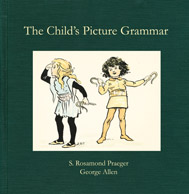
This child's picture book, first published in 1900, uses illustrations to personify the eight parts of speech. Cool!

1. Nouns
Nouns name people, places, things, or ideas.
There are many different types of nouns. Here are a few: proper nouns, common nouns, collective nouns, and compound nouns.
2. Pronouns
Pronouns take the place of nouns.
Just like nouns, there are many different types of pronouns. Here are a few of them: reflexive pronouns, indefinite pronouns, possessive pronouns, and relative pronouns.
3. Verbs
Verbs show actions or states of being.
Linking verbs, action verbs, and helping verbs are described on the page above. Modals are described here, and you can learn even more about action verbs here.
4. Adjectives
Adjectives describe, or modify, nouns and pronouns.
5. Adverbs
Adverbs modify verbs, adjectives, and other adverbs
6. Prepositions
Prepositions show the relationship between a noun or a pronoun and some other word in the rest of the sentence.
7. Conjunctions
Conjunctions join two or more words, phrases, or clauses
8. Interjections
Interjections show excitement or emotion. They are not grammatically related to the rest of the sentence.